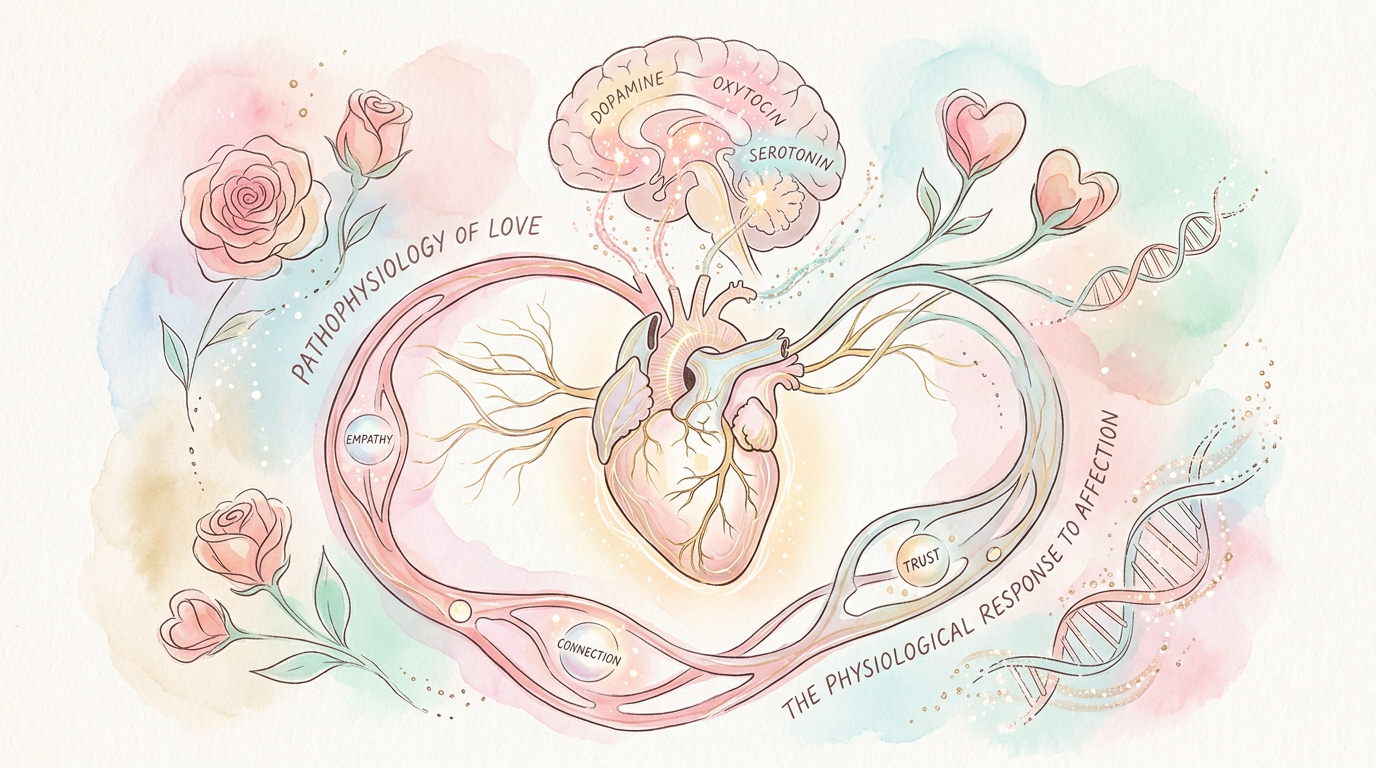
I’ve always wondered what physically happens to us when we fall in love.
Why does seeing one particular person make your heart race? Why can’t you stop thinking about them? Why can you lose your appetite, stay awake half the night, and make decisions you normally wouldn’t make?
And then, if the relationship ends, why can heartbreak cause actual chest pain, nausea, insomnia, anxiety, and depression?
We call it “falling in love,” but there is a lot happening physiologically when we do.
It Starts in the Brain
Although we associate love with the heart, romantic love actually begins largely in the brain.
When we become intensely attracted to someone, several interconnected brain systems become involved, particularly areas responsible for reward, motivation, emotion, attention, stress, and attachment.
One important pathway is the brain’s mesolimbic reward system.
This system includes structures such as the ventral tegmental area (VTA) and nucleus accumbens.
The VTA contains neurons that produce dopamine and send signals to other parts of the brain involved in reward and motivation.
When we’re around someone we’re strongly attracted to—or sometimes even when we’re simply thinking about them—this reward circuitry can become activated.
Dopamine signaling increases the person’s salience.
In other words, your brain begins treating that person as something extremely important.
This helps explain why one person can suddenly dominate your thoughts.
Dopamine: Why We Want More
Dopamine is often called the “pleasure chemical,” but that’s an oversimplification.
Dopamine is strongly involved in:
- Motivation
- Reward learning
- Anticipation
- Attention
- Reinforcement
- Goal-directed behavior
When something produces a rewarding experience, the brain learns to seek it again.
The person you’re falling in love with can essentially become associated with reward.
Their text becomes rewarding.
Their attention becomes rewarding.
Physical affection becomes rewarding.
Sex becomes rewarding.
Even anticipating seeing them can activate reward-related processes.
Your brain begins learning:
This person = something I want.
This helps explain the almost compulsive desire to see someone, check your phone, wait for their messages, or think about them repeatedly.
Why Uncertainty Can Make Attraction Even More Intense
The dopamine system doesn’t respond only to receiving rewards.
It also responds to anticipation and prediction.
The brain constantly learns what predicts a reward.
If someone texts you and it makes you happy, the notification on your phone can eventually become associated with that reward.
That’s why your heart can jump before you’ve even seen who sent the message.
Unpredictable rewards can be particularly powerful.
When you don’t know when someone will call or text, anticipation remains high.
Your brain keeps waiting for the next reward.
This is one reason early relationships can become so mentally consuming.
Norepinephrine: The Racing Heart and Butterflies
Falling in love also activates systems involved in physiological arousal.
One important chemical involved is norepinephrine, also called noradrenaline.
Norepinephrine functions both as a neurotransmitter in the brain and as part of the body’s sympathetic response.
The sympathetic nervous system is the branch of the autonomic nervous system responsible for preparing the body for action.
When sympathetic activity increases, you may experience:
- Increased heart rate
- Increased blood pressure
- Faster breathing
- Sweating
- Trembling
- Dilated pupils
- Increased alertness
That nervous, energized feeling around someone you’re attracted to isn’t purely psychological.
Your autonomic nervous system is responding too.
Why We Get Butterflies
The gastrointestinal tract is heavily connected to the brain through the gut-brain axis.
During sympathetic activation, the body shifts resources toward systems needed for immediate action.
Digestive activity can change.
At the same time, autonomic signals alter gastrointestinal movement and sensation.
The result can be:
- Butterflies
- Nausea
- Decreased appetite
- A “knot” in the stomach
- Changes in bowel habits
So when someone says they can’t eat because they’re falling in love—or because their heart has been broken—there can be a real physiological explanation.
Cortisol: Love Can Also Be Stressful
Early romantic love isn’t purely a reward response.
It can also involve the body’s stress system.
One of the body’s major stress pathways is the hypothalamic-pituitary-adrenal axis, or HPA axis.
The process works roughly like this:
Hypothalamus → Pituitary gland → Adrenal glands → Cortisol
The hypothalamus releases corticotropin-releasing hormone.
This stimulates the pituitary gland to release adrenocorticotropic hormone, or ACTH.
ACTH travels through the bloodstream to the adrenal cortex.
The adrenal glands then release cortisol.
Cortisol helps the body mobilize energy and respond to stress.
That doesn’t necessarily mean being in love is unhealthy.
It means that excitement, uncertainty, vulnerability, and emotional arousal can activate some of the same physiological systems the body uses during other stressful situations.
Why You Can’t Stop Thinking About Someone
During intense romantic attraction, attention can become unusually focused on one individual.
Dopamine contributes to salience, meaning the brain assigns greater importance to certain stimuli.
The person’s face matters.
Their voice matters.
Their messages matter.
Their behavior matters.
Small details that normally wouldn’t deserve much attention suddenly become extremely important.
This can contribute to repetitive thinking:
Why hasn’t he called?
What did that text mean?
When will I see him again?
The brain has essentially tagged that individual as highly significant.
What Happens to Serotonin?
Serotonin is frequently mentioned in discussions about romantic love.
Some research has found altered serotonin-related activity during early romantic attachment, and researchers have explored similarities between the repetitive thinking seen in intense romantic love and obsessive thinking.
However, the relationship isn’t simple enough to say:
“Falling in love lowers serotonin.”
Human serotonin activity is complicated, and romantic love can’t be explained by measuring one neurotransmitter.
It’s better to think of love as the result of multiple interacting neural systems, rather than a single chemical imbalance.
Oxytocin and the Development of Attachment
As relationships develop, another system becomes increasingly important:
attachment.
One hormone strongly associated with social bonding is oxytocin.
Oxytocin is produced primarily in the hypothalamus and released through the posterior pituitary, while also acting within the brain.
It is involved in several forms of social and reproductive behavior, including:
- Childbirth
- Breastfeeding
- Sexual activity
- Social bonding
- Attachment
Physical contact such as hugging, kissing, cuddling, and sexual activity can be associated with oxytocin release.
Oxytocin doesn’t simply create love, but it participates in neural systems involved in social bonding.
Vasopressin and Pair Bonding
Another hormone associated with attachment is vasopressin.
Vasopressin is best known clinically for regulating water balance and vascular tone, but it also has functions within the brain.
Research—particularly animal research—has linked vasopressin signaling with pair bonding, social recognition, and attachment behaviors.
Human relationships are obviously much more complicated than hormone levels, but oxytocin and vasopressin appear to participate in the biological systems that allow humans to form strong social attachments.
The Brain Eventually Learns the Person
Over time, your partner becomes associated with more than pleasure.
They become associated with:
Safety. Comfort. Routine. Familiarity. Attachment.
Your brain is constantly making predictions based on previous experiences.
If someone sleeps beside you every night, calls you every afternoon, eats dinner with you, touches you, comforts you, and participates in your daily routine for years, your nervous system learns to expect that person’s presence.
Thousands of repeated experiences reinforce those neural associations.
Then imagine that person suddenly disappears.
The relationship ends.
The reward is gone.
The physical contact is gone.
The routines are gone.
But the neural pathways and expectations don’t disappear overnight.
This is where the physiology of heartbreak becomes particularly interesting.
What Happens to the Brain During Heartbreak?
When an attachment is suddenly disrupted, the brain encounters something it didn’t predict.
It expected:
Person → comfort/reward
Instead it receives:
Person → absent
Yet reward and motivation circuits may remain responsive to reminders of that person.
That’s one reason someone can logically understand that a relationship is over while still experiencing an intense urge to contact their former partner.
The cognitive part of the brain understands:
It’s over.
The reward and attachment systems may still be saying:
Find them.
Heartbreak Activates the Stress Response
Loss and social rejection can activate the body’s stress-response systems.
The HPA axis can increase cortisol production.
The sympathetic nervous system can also become more active.
That can produce very real physical symptoms:
- Increased heart rate
- Palpitations
- Elevated blood pressure
- Chest tightness
- Sweating
- Trembling
- Gastrointestinal upset
- Loss of appetite
- Difficulty sleeping
- Fatigue
- Difficulty concentrating
If stress persists, chronically altered cortisol and autonomic activity can affect multiple body systems.
This is why severe emotional stress isn’t simply “in your head.”
The brain is an organ, and its response to emotional stress produces physiological changes throughout the body.
Why Emotional Pain Can Feel Like Physical Pain
One of the most fascinating areas of research involves the overlap between social pain and physical pain.
Brain-imaging studies suggest that social rejection and physical pain can recruit some overlapping neural regions, including areas of the anterior cingulate cortex and insula.
That doesn’t mean heartbreak and a physical injury are identical.
But the brain does not completely separate social distress from physical distress.
From an evolutionary perspective, this makes sense.
Humans evolved as highly social animals.
Historically, separation from family or a social group could threaten survival.
Our brains therefore developed powerful mechanisms encouraging us to form and maintain social bonds.
Losing an important attachment isn’t something the nervous system necessarily treats casually.
Why Your Chest Can Actually Hurt
Severe anxiety and emotional stress can cause muscle tension, increased heart rate, altered breathing patterns, increased sympathetic activity, and heightened awareness of sensations in the chest.
All of these can contribute to the sensation people describe as their heart physically hurting.
But there is also a genuine cardiac condition associated with severe emotional stress.
It’s called Takotsubo cardiomyopathy, commonly known as broken heart syndrome.
During Takotsubo cardiomyopathy, a surge of stress-related catecholamines is believed to contribute to temporary dysfunction of the heart’s left ventricle.
The ventricle can develop an abnormal contraction pattern and temporarily become less effective at pumping blood.
Symptoms may include:
- Sudden chest pain
- Shortness of breath
- ECG abnormalities
- Elevated cardiac biomarkers
It can closely resemble an acute myocardial infarction.
The condition often follows intense physical or emotional stress, although it can occur without an obvious trigger.
Most heartbreak does not cause Takotsubo cardiomyopathy.
But the existence of the condition demonstrates something remarkable:
Extreme emotional stress really can affect the mechanical function of the heart.
And because chest pain and shortness of breath can also indicate a heart attack or another medical emergency, new or severe symptoms should never simply be assumed to be anxiety or heartbreak.
Why Heartbreak Can Feel Like Withdrawal
People often describe heartbreak as withdrawal.
There is some biological reasoning behind the comparison.
Your brain has repeatedly associated one person with reward.
Then that reward disappears.
But the neural circuitry involved in wanting, motivation, and attachment doesn’t necessarily shut off immediately.
So you seek reminders of the reward.
You look at pictures.
You reread messages.
You check social media.
You want to hear their voice.
You want to contact them.
And when you do receive some reminder or interaction, it can temporarily satisfy that craving.
This reinforces the cycle.
It isn’t accurate to say romantic heartbreak is identical to drug withdrawal.
But both can involve brain systems related to reward, motivation, reinforcement, and craving.
Why Heartbreak Can Cause Depression
Heartbreak is a major psychological stressor.
Loss can disturb several systems simultaneously:
Reward: Something previously associated with pleasure is gone.
Attachment: An important social bond has been disrupted.
Stress: Cortisol and sympathetic activity may increase.
Sleep: Rumination and physiological arousal interfere with normal sleep.
Appetite: Autonomic and stress responses can alter hunger and digestion.
Behavior: People may withdraw socially and stop doing activities that previously provided reward.
When several of these things happen at once, someone may experience profound sadness, low motivation, fatigue, difficulty concentrating, sleep disturbances, appetite changes, and feelings of hopelessness.
For many people these reactions gradually improve.
For others, symptoms can become persistent or severe enough to meet criteria for a depressive disorder and require professional treatment.
Why Does Time Heal Heartbreak?
This might be the most interesting part.
People always say:
“Time heals.”
Physiologically, time gives the brain an opportunity to adapt and learn new predictions.
Initially, thousands of environmental cues may remind you of the person.
A restaurant.
A song.
Saturday mornings.
Their perfume.
Your bedroom.
A certain street.
Your phone.
Those cues activate memories and expectations associated with the relationship.
But if those cues repeatedly occur without the former partner being present, the brain gradually learns a new association.
The phone rings.
It isn’t them.
Saturday comes.
You make different plans.
You go to the restaurant.
You eat there without them.
You fall asleep alone.
You wake up.
You survive.
This process involves neuroplasticity—the nervous system’s ability to modify its connections and responses based on experience.
New routines develop.
New reward associations form.
Stress responses become less intense.
The expectation of the person’s presence gradually weakens.
Eventually the memory remains, but the physiological reaction attached to that memory may become much smaller.
You haven’t necessarily forgotten the person.
Your nervous system has adapted to their absence.
So Is Love Really a Chemical Reaction?
Yes.
And no.
Dopamine matters.
Norepinephrine matters.
Cortisol matters.
Oxytocin matters.
Vasopressin matters.
The autonomic nervous system matters.
The HPA axis matters.
The reward system matters.
Memory and neuroplasticity matter.
But none of these individually is love.
Love emerges from enormously complicated interactions between the brain, nervous system, hormones, memories, experiences, personality, attachment, culture, and another human being.
So when someone says:
“You make my heart race.”
There’s physiology behind that.
When they say:
“I can’t eat.”
There’s physiology behind that too.
When they say:
“I can’t stop thinking about him.”
The brain’s attention and reward systems are involved.
And when someone who’s devastated says:
“My heart actually hurts.”
That feeling shouldn’t automatically be dismissed as being dramatic.
Because perhaps the most interesting thing I’ve learned about love is this:
We may experience love emotionally, but our entire body participates in it.
Leave a Reply